Have you ever seen fingers across a fabric and felt a history which connects life through its patterns?
That’s the most amazing part of hand-printing in which tradition, and creativity come together on fabric. In the world of mass production, hand-printing on cloth is like a reminder of the human touch behind real artistry.
Reading this blog, we will understand the traditions and techniques which makes hand-printing a powerful tool. Even if you are a craft fan, fashion supporter, or just wanted to know about the rooting of textiles, then this blog is for you. This will make you feel that you are in a journey of history and heritage of timeless charm of handmade fabric.
Historical Overview of Fabric Hand-Printing
Let’s start with ancient roots and cultural significance of hand-printing on fabric:
Fabric hand-printing is thousands of years old, with evidence found in ancient Egypt 3000BCE, where linen was printed with blocks. These techniques were more than just decorative ideas, but they are symbols of cultural identity, spirituality, and social status.
How does this technique evolve?
After the advancement of civilization, hand-printing evolved. In China, woodblock printing emerged during the Han dynasty (206 BCE – 220 CE), where many resist dye methods developed across India, Africa, and South Asia. After this, Europe started experimenting with stencil and copperplate printing, blending precision with artistry. This advancement put the groundwork for modern textile designs and fabric printing.
India’s history of hand-printing – India is a hub of hand-printing, from Bagru, Sanganer, and Dabu from the Indus Valley Civilization. Also, Kalamkari technique during the times of Mughals combined hand-drawing with natural dyeing to create narrative and ornamental designs.
China’s history – Perfection in block and wax-resist printing among tribals like Miao and Gejja, with the use of indigo and beeswax to make symbolic motifs.
What are the core techniques of Hand-Printing?
Below are some technique:-
Block Printing
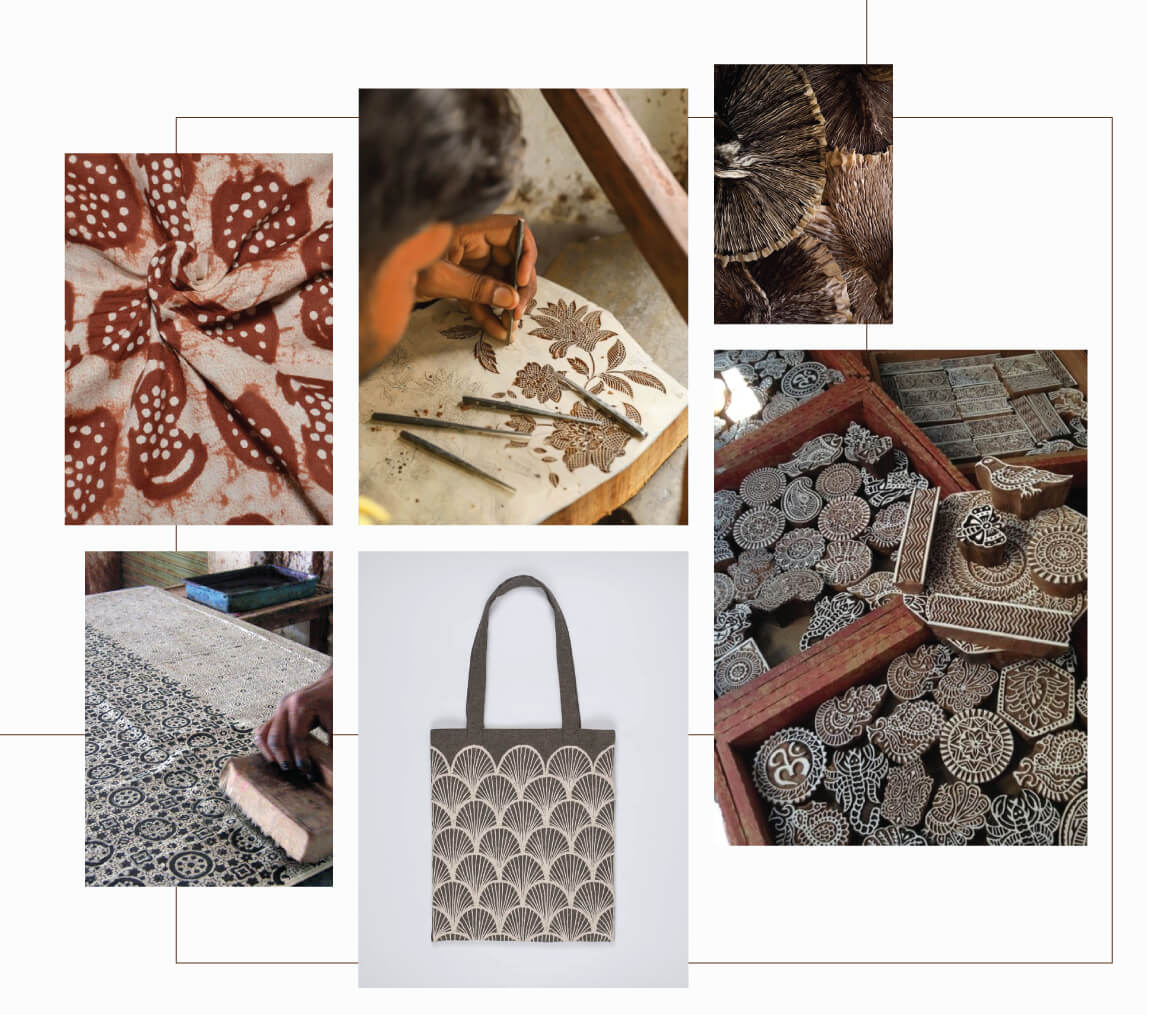
These are one of the oldest printing methods, where artisans carve tangled designs into wooden blocks, followed by dipping into them in dye, and stamp them into fabrics.
Screen Printing
Mesh screen is used with stencil to apply ink onto fabric. Modern but still needs hands-on skill, to make it ideal for bold, graphic designs and moderate production.
Stencil Printing
Direct method, where stencil printing uses cut-out templates to paint or dye on the fabric. This is the most simple approach and has been used across cultures for centuries to make repeat patterns.
Resist Printing
Here some parts of fabrics are protected to avoid dye from seeping through, Batik (uses wax to draw), Tie-dye and Shibori (folding, binding, or stitching fabric before dye to create organic patterns.
And here comes a technique from India, which is Kalamkari and others, where combination of freehand drawing with natural dyeing with the help of pens and blocks, makes mythological stories or floral patterns.
Other Indian techniques such as – Sanganer, Bagru, and Ajrakh are a mixture of resist and block printing that passed down for generations.
Materials and Tools used in Hand-Printing
Dyes, Pigments and Natural Colors for the fabrics – Traditional printing depends on plant based and mineral dyes, which includes, Indigo for blues, Turmeric for yellow, Pomegranate for red, Iron and Alum for black.
Tools –Wooden block which represents one color or layer of the pattern, Screens is a fine mesh over frames for screen printing, Stencils for quick & bold motifs made from rubber or curved wood, and Bushes & Pens used for kalamkari with freehand precision.
Best Fabrics for Hand-Printing – Natural fibres like, khadi, crepe, georgette, cotton and wool are most suited ones because these can absorb dyes very well and retain patterns vividly.
Combination of these tools & materials are the foundation of hand-printing.
Sustainability and the Slow Fashion Movement
Hand-Printing is more eco-friendly than machine printing because it uses natural dyes, less water, and no heavy machinery, which makes it a minimal pollutant.
Selecting hand-printed textiles will always help sustain local artisans and their families as these crafts support traditional livelihoods. It carries generations of cultural knowledge, from block carving to natural dyeing; these support to keep heritage skills alive and best for the future.
Conclusion
Summing up this blog, we understood that Hand-Printing celebrates the beauty of imperfection, where each and every mark tells a story. It is a timeless attraction with uniqueness and cultural richness.
Opting hand-printed textiles is a mindful, meaningful, sustainable step toward the future!